What Is a Gas Detector and How Does It Work?
, 7 min reading time
, 7 min reading time
A gas detector is a safety device used to identify the presence of harmful gases in the air. It helps prevent accidents caused by gas leaks, toxic gases, or a lack of oxygen. Gas detectors are widely used in homes, factories, warehouses, laboratories, and confined spaces.
If you are searching for what a gas detector does, how it works, or which type you should choose, this guide explains everything in simple, clear language.
A gas detector (also called a gas monitor) is a device that continuously monitors the surrounding air and alerts users when dangerous gas levels are detected. Depending on the model, it can detect:
Toxic gases (CO, H₂S, NH₃, Cl₂, O₃, etc.)
Combustible gases (CH₄, propane, natural gas)
Oxygen levels (O₂ deficiency or O₂ enrichment)
VOCs (volatile organic compounds)
Gas detectors can be portable (handheld units) or fixed (installed on walls or ceilings). Many industries require gas monitors to ensure worker safety and meet regulatory standards.
Common Applications:
Oil & gas plants
Confined space entry
Home gas leak detection
Warehouses & manufacturing
Laboratories & chemical handling
HVAC & maintenance work
Gas leaks are often invisible and odorless. A detector gives you early warning before a dangerous situation develops. The right gas detector helps:
✔ Prevent poisoning
✔ Avoid explosions or fires
✔ Detect oxygen deficiency
✔ Improve workplace safety compliance
✔ Protect workers in hazardous environments
For homes, it can detect carbon monoxide or combustible gases, preventing life-threatening accidents.
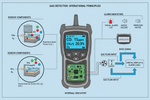
Gas detectors use sensors to analyze the air and identify gas concentration. When the concentration reaches a dangerous level, the device triggers an alarm through sound, light, and vibration.
Electrochemical sensors work by producing an electric current when specific gas molecules react with an internal chemical solution.
How it works:
Gas enters the sensor
A chemical reaction occurs
The reaction generates a tiny electrical current
The current is converted into a gas concentration reading
Benefits:
High accuracy
Low power consumption
Excellent selectivity (reacts only to specific gases)
Very stable and reliable
This is the most common sensor type for CO, H₂S, oxygen, and other toxic gases.
Semiconductor sensors use heated metal oxide materials that change resistance when exposed to certain gases.
Features:
Affordable
Good for home-use gas leak detection
Sensitive to many gases (may cause false alarms)
Catalytic sensors detect flammable gases by oxidizing the gas on a heated catalyst bead.
How it works:
Combustible gas burns slightly on the sensor
Temperature change alters electrical resistance
Device calculates the gas concentration (LEL level)
Used mostly in industrial gas detectors for methane, propane, and other flammable gases.
Infrared sensors detect gases by measuring how gas molecules absorb IR light.
Advantages:
Very stable and long lifespan
Ideal for CO₂ or hydrocarbon detection
Not affected by oxygen levels or humidity
Common in industrial fixed gas detection systems.
PID sensors detect VOCs (volatile organic compounds) at extremely low levels.
How they work:
UV light ionizes gas molecules
The sensor measures the ionization current
Gives real-time VOC readings
Used in environmental monitoring and chemical manufacturing.
A gas detector uses multiple alerts to ensure safety:
Audible Alarm → High-volume beeping
Visual Alarm → Flashing LED lights
Vibration (portable models) → Alerts workers in noisy areas
Display → Shows gas concentration ppm or %LEL
These alarms activate automatically when gas levels exceed preset safety limits.
Detect one gas only (e.g., CO, O₂, H₂S).
Lightweight
Cost-effective
Ideal for specific applications
Detect 2, 3, or 4 gases simultaneously.
Common 4-in-1 detectors monitor:
O₂
CO
H₂S
Combustible gases (LEL)
Perfect for industrial safety and confined space entry.
Wall-mounted devices that detect:
Natural gas
Propane
Carbon monoxide
24/7 monitoring for factories, warehouses, tunnels, or chemical plants.
When selecting a gas detector, consider:
Which gases you need to detect
Indoor vs. outdoor use
Portable vs. fixed installation
Sensor type (electrochemical, IR, catalytic)
Certification requirements (CE, UL, ATEX, IECEx)
Calibration and maintenance needs
Alarm type and battery life


