Electrochemical vs. Infrared Gas Sensors: Which Is More Accurate?
, 8 min reading time
, 8 min reading time
Choosing the right gas sensor is one of the most important decisions when selecting a gas detector. The two most widely used technologies today are electrochemical sensors and infrared (IR) sensors. Both detect gases, but they work in completely different ways and offer different levels of accuracy, stability, and long-term performance.
This guide explains the differences in clear, simple language so you can choose the best option for home safety, industrial use, or professional gas monitoring.
Electrochemical sensors are used to detect toxic gases such as:
Carbon monoxide (CO)
Hydrogen sulfide (H₂S)
Nitrogen dioxide (NO₂)
Sulfur dioxide (SO₂)
Oxygen (O₂) concentration
These sensors generate an electrical current when gas molecules react with chemicals inside the sensor.
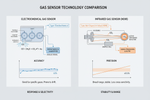
Target gas enters the sensor
Gas molecules react with an electrolyte
This reaction produces an electrical current
Current strength = gas concentration
Very high accuracy for toxic gases
Strong gas selectivity
Low power consumption
Affordable for portable detectors
Ideal for confined space and industrial safety
Lifespan usually 2–3 years
Sensitive to extreme temperatures
Specific to certain gases (not universal)
Electrochemical sensors remain the most reliable choice for toxic gas detection.
Infrared gas sensors detect gases that absorb infrared light. They are widely used for:
CO₂ (carbon dioxide)
Hydrocarbon gases (methane, propane, etc.)
Refrigerants
Flammable gases in industrial environments
IR light passes through the air inside the sensor
Gas molecules absorb specific IR wavelengths
A detector measures how much light was absorbed
The device calculates gas concentration
Extremely stable and long lifespan
Not affected by oxygen levels
Excellent for CO₂ and hydrocarbons
Low maintenance
Fast response time
Immune to sensor poisoning
Cannot detect gases that do not absorb IR (e.g., H₂S, CO in simple IR systems)
More expensive than electrochemical sensors
Larger in size (in most designs)
IR sensors dominate CO₂ detection and hydrocarbon leak monitoring.
Electrochemical sensors provide industry-leading accuracy for gases like CO, H₂S, and O₂. Their chemical reaction is highly selective, giving precise readings even at very low concentrations (ppm level).
Accuracy Highlights:
Excellent for personal safety monitoring
Very precise at low gas levels
Minimal cross-interference
For toxic gases, electrochemical sensors are the most accurate option.
Infrared technology is extremely accurate for gases that strongly absorb IR spectra:
CO₂
Methane
Propane
Refrigerants
IR sensors are known for:
Very stable measurements
No sensor drift
Long-term calibration stability
High accuracy for LEL (lower explosive limit) monitoring
For CO₂ or flammable hydrocarbon detection, IR sensors are more accurate than electrochemical or catalytic types.
| Feature | Electrochemical Sensor | Infrared (IR) Sensor |
|---|---|---|
| Best for detecting | CO, H₂S, NO₂, SO₂, O₂ | CO₂, methane, propane, hydrocarbons |
| Accuracy | ★★★★★ (toxic gases) | ★★★★★ (CO₂ & hydrocarbons) |
| Stability | Moderate | Very high |
| Lifespan | 2–3 years | 5–10+ years |
| Cross-interference | Low | Very low |
| Cost | Lower | Higher |
| Sensitivity at low levels | Strong | Strong |
| Environment impact | Sensitive to temp/humidity | Stable in harsh conditions |
| Detects flammable gases? | No | Yes (for IR-absorbent gases) |
Carbon monoxide
Hydrogen sulfide
Oxygen levels
Nitrogen dioxide
Sulfur dioxide
Best for:
Confined space entry
Industrial toxic gas detection
Portable 4-in-1 gas detectors
Personal safety and PPE devices
CO₂
Hydrocarbon gases (CH₄, C₃H₈, etc.)
Refrigerants
Combustible gas LEL levels
Best for:
HVAC & indoor air quality monitoring
Industrial hydrocarbon leak detection
Greenhouses & enclosed rooms
Fixed gas detection systems
There is no single “winner”—each sensor is more accurate for its intended gas type:
Electrochemical = most accurate for toxic gases
Infrared = most accurate for CO₂ and hydrocarbons
For the highest safety and reliability, many professional gas detectors combine both technologies in one device.


